



Loading your cart...

A whole food supplement is a nutritional product derived entirely from concentrated, minimally processed whole foods that preserves the natural nutrient matrix as it exists in nature. This definition separates whole food supplements from the synthetic vitamins that dominate most pharmacy shelves. Understanding what does whole food supplement mean gives you a clearer picture of why source and form matter as much as nutrient quantity. Whole food supplements retain the broad spectrum of naturally occurring vitamins, minerals, and supporting cofactors, delivering nutrition as part of a biological system rather than as isolated chemical compounds. Mycelia Link builds its entire product philosophy around this principle.
What does whole food supplement mean compared to synthetic options?
Synthetic supplements contain isolated chemical compounds without the natural cofactors that help your body recognize and use them. A synthetic vitamin C tablet delivers ascorbic acid alone. A whole food vitamin C source, such as concentrated acerola cherry or camu camu, delivers ascorbic acid alongside bioflavonoids, enzymes, and trace phytonutrients that work together in your body. That difference in delivery is the core of the whole food supplement definition.
Nutrients do not work in isolation. Whole foods offer a synergistic complex that isolated supplements simply cannot replicate. This synergy affects how vitamins and minerals are absorbed and utilized at the cellular level. When a nutrient arrives packaged with its natural cofactors, your body processes it through pathways it evolved to use.
Synthetic vitamins focus on quantity but lack the surrounding food-based components that influence absorption and utilization. Whole food supplements emphasize natural complexes, supporting ongoing foundational nutrition rather than flooding the body with a single compound. The practical result is a more complete nutritional signal.

| Feature | Whole food supplements | Synthetic supplements |
|---|---|---|
| Nutrient source | Concentrated whole foods | Isolated chemical compounds |
| Cofactors present | Yes, enzymes and phytonutrients | No, stripped during synthesis |
| Absorption pathway | Mirrors natural food digestion | Often requires separate cofactors |
| Digestive tolerance | Generally gentler on the stomach | Can cause gastric discomfort |
| Nutritional complexity | Broad spectrum, synergistic | Single or limited nutrient focus |
What are the main benefits of whole food supplements?
The primary benefit of whole food supplements is improved bioavailability. The nutrient matrix preserves enzymes, cofactors, and phytonutrients that aid recognition and absorption at the cellular level. Synthetic isolates lack these transport elements, which reduces their effectiveness and often leads to early excretion from the body.
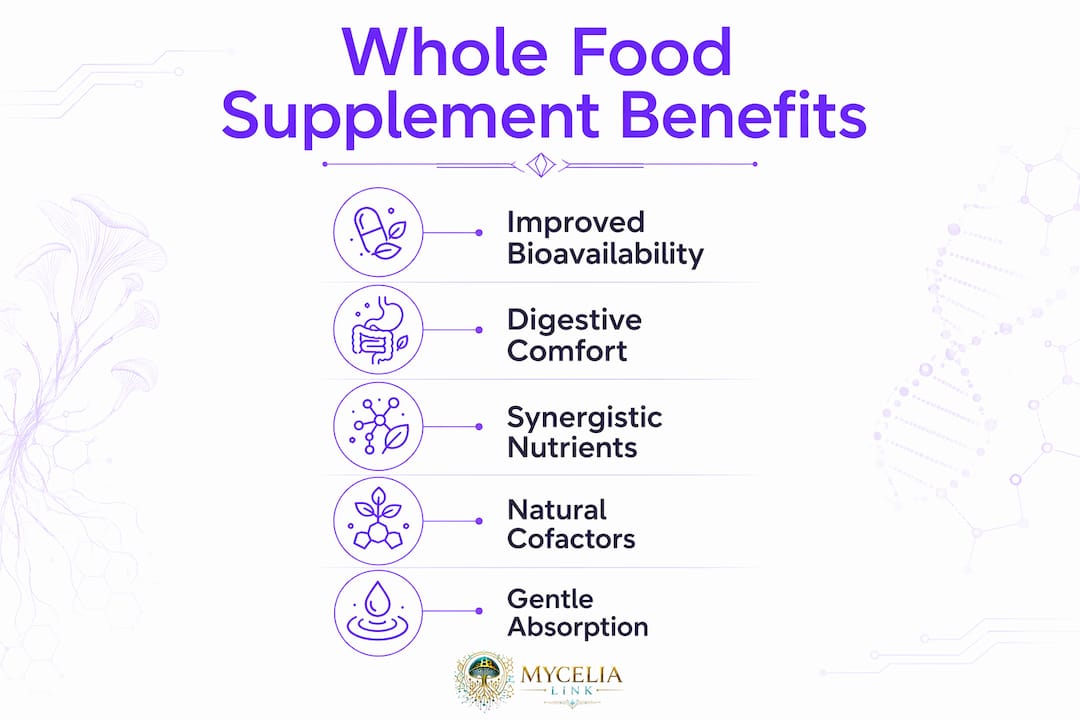
Digestive comfort is a second major advantage. Consumers frequently experience less gastric discomfort from whole food supplements compared to synthetic multivitamins. This matters practically because a supplement you can take consistently, without nausea or stomach upset, delivers more long-term value than one you skip.
The benefits of whole food supplements also include nutrient synergy that no laboratory formulation fully replicates. The human body is evolutionarily adapted to digest complex biological delivery systems found in whole plants. Whole food supplements align with that natural processing, which is why clinical research continues to favor food matrix delivery over isolated extracts.
Key benefits at a glance:
- Bioavailability: Nutrients arrive with their natural cofactors, so absorption rates are higher than with isolated compounds.
- Digestive tolerance: Whole food forms are gentler on the stomach, making consistent use more realistic.
- Nutrient synergy: Vitamins, minerals, and phytonutrients interact as they do in real food, amplifying each other’s effects.
- Broader nutritional coverage: A single whole food source contributes multiple nutrients simultaneously, not just one.
- Reduced excretion waste: Because the body recognizes the delivery system, fewer nutrients are flushed out unused.
Pro Tip: When evaluating a whole food supplement label, look for the actual food source listed as the primary ingredient, such as “spinach powder” or “reishi mushroom extract.” If the label leads with a chemical name like “ascorbic acid” or “retinyl palmitate,” the product is synthetic, not whole food-based.
What are common whole food supplements examples?
Whole food supplements draw from a wide range of concentrated plant and fungal sources. The format varies, but the principle stays the same: the food is dried, concentrated, and delivered in a way that preserves its natural nutrient profile.
- Leafy greens and vegetables: Spinach, kale, broccoli, and wheatgrass are dried and powdered to concentrate their vitamins, minerals, and chlorophyll. These form the base of many “greens” powders and capsule blends.
- Fruits and berries: Acerola cherry, amla, and camu camu are used as whole food vitamin C sources. Grape and pomegranate are concentrated for their polyphenol content. A clinical trial showed that a whole food grape matrix outperformed concentrated grape extract for post-meal triglyceride response, confirming that the full food matrix matters.
- Herbs and roots: Turmeric root, ginger, and ashwagandha are minimally processed and encapsulated to preserve their active compounds alongside their natural cofactors.
- Functional mushrooms: Lion’s mane, reishi, chaga, and cordyceps are among the most studied whole food supplement sources. These fungi deliver beta-glucans, triterpenes, and other bioactive compounds in a form the body processes efficiently. You can learn more about how these compounds work in this functional mushroom supplement guide.
- Algae and sea vegetables: Spirulina, chlorella, and kelp are nutrient-dense whole food sources used in powder and tablet form, particularly for minerals and essential fatty acids.
Formats include powders mixed into water or smoothies, capsules for convenience, and pressed tablets. Powders tend to preserve the broadest nutrient profile because they require less processing than tablets. Capsules offer the most practical daily use for people who want a consistent dose without preparation.
How to use whole food supplements effectively
Whole food supplements work best as support tools alongside a real-food diet, not as replacements for one. They provide nutrients in a bioavailable, synergistic form but do not replace the energy, fiber, and full nutritional complexity of eating whole foods. Registered dietitians consistently frame supplementation as a complement to eating well, not a shortcut around it.
Certain situations make whole food supplementation especially practical. Urban lifestyles often limit access to fresh, nutrient-dense produce. Soil depletion over decades has reduced the mineral content of many commercially grown vegetables, meaning even a good diet may fall short on specific nutrients. Whole food supplements fill those gaps without introducing synthetic compounds your body has to work harder to process.
Reading labels carefully is the most important skill you can develop as a supplement buyer. Look for minimal ingredient lists where the food source is the first item. Avoid products with long lists of synthetic additives, artificial colors, or preservatives. Transparency about sourcing and third-party testing signals a manufacturer that prioritizes quality over marketing. Mycelia Link’s guide on evaluating transparency claims walks through exactly what to look for on a supplement label.
Pro Tip: Take whole food supplements with a meal whenever possible. Because they mirror real food, they absorb best in the presence of other food-based compounds, particularly healthy fats for fat-soluble nutrients like vitamins A, D, E, and K.
The FDA regulates dietary supplements as foods, not drugs, which means no supplement can legally claim to treat or cure a disease. This regulatory context reinforces the role of whole food supplements as nutritional tools, not medical treatments. Understanding that boundary helps you set realistic expectations and make better purchasing decisions.
Key Takeaways
Whole food supplements deliver nutrients within their natural biological matrix, making them more bioavailable, gentler on digestion, and more synergistically effective than synthetic isolates.
| Point | Details |
|---|---|
| Definition clarity | Whole food supplements concentrate real foods to preserve their full nutrient matrix, not isolated compounds. |
| Bioavailability advantage | Enzymes, cofactors, and phytonutrients in whole food forms improve how your body absorbs and uses nutrients. |
| Digestive tolerance | Whole food supplement forms cause less gastric discomfort than synthetic multivitamins for most people. |
| Practical use | Take whole food supplements alongside a real-food diet, not as a replacement for one. |
| Label reading | Choose products where the food source, not a chemical name, appears first on the ingredient list. |
Whole food supplements and the complexity we keep underestimating
The supplement industry has spent decades selling the idea that more of a nutrient is always better. I’ve watched that assumption cause real confusion for people who take high-dose synthetic vitamins and still feel nutritionally flat. The issue is not the quantity. The issue is the delivery system.
What strikes me most about whole food supplementation is how it reframes the question entirely. Instead of asking “how much vitamin C should I take,” the better question is “what form of vitamin C does my body actually recognize?” The answer, consistently, points back to food matrix delivery. A concentrated acerola cherry provides ascorbic acid the same way an orange does, packaged with the compounds that make absorption possible.
The misconception I see most often is treating supplements as a separate category from food. They are not. A quality whole food supplement is closer to a concentrated food than it is to a pharmaceutical. When you start thinking about them that way, the sourcing questions become obvious: Where did this food come from? How was it processed? What is still intact after manufacturing?
Mycelia Link’s approach to supplement absorption reflects this thinking. The goal is not to flood the body with isolated nutrients. The goal is to support the body’s existing biological infrastructure with nutrients it already knows how to use.
— Mycelia Link Industries
Mycelia Link’s whole food and mushroom supplement offerings
Mycelia Link specializes in functional mushroom supplements that represent whole food nutrition at its most concentrated. Every product is third-party tested and formulated to preserve the natural nutrient matrix that makes whole food supplementation worth choosing over synthetic alternatives.

Functional mushrooms like lion’s mane, reishi, and chaga are among the most nutrient-dense whole food sources available. Mycelia Link’s mushroom supplement category includes products sourced with full ingredient transparency, so you know exactly what food source you are getting and how it was processed. No inflated prices, no opaque marketing. For readers who want to go deeper on sourcing and formulation standards, the mushroom supplements category page offers curated options with educational context for every product.
FAQ
What does whole food supplement mean in simple terms?
A whole food supplement is a nutritional product made from concentrated, minimally processed real foods that retains the natural vitamins, minerals, enzymes, and cofactors found in those foods. It differs from synthetic supplements, which contain isolated chemical compounds without their natural supporting components.
Are whole food supplements more effective than synthetic vitamins?
Clinical evidence supports better physiological outcomes from whole food matrices. A whole food grape matrix, for example, outperformed concentrated grape extract in a clinical trial measuring post-meal triglyceride response, suggesting the full food matrix delivers superior results.
What are the best examples of whole food supplements?
Common examples include concentrated greens powders from spinach or kale, acerola cherry for vitamin C, functional mushrooms like lion’s mane and reishi, spirulina, and turmeric root capsules. Each delivers nutrients alongside their natural cofactors.
How do I know if a supplement is truly whole food-based?
Check the ingredient list. A genuine whole food supplement lists the food source, such as “broccoli sprout powder” or “lion’s mane mushroom,” as the primary ingredient. If the label leads with chemical names like “cyanocobalamin” or “dl-alpha-tocopherol,” the product is synthetic.
Can whole food supplements replace eating whole foods?
No. Whole food supplements complement a balanced diet but do not replace it. They lack the fiber, caloric energy, and full nutritional complexity of eating real food, and the FDA does not permit supplements to make disease treatment claims.
Recommended
Categories:
Related Posts
 How Beta-Glucans Support Immunity in Athletes
Discover how beta-glucans support immunity in athletes. Learn about their benefits, including reduced URTI severity
 The Role of Antioxidants in Wellness: 2026 Guide
Discover the role of antioxidants in wellness. Learn how they support immune functions, reduce inflammation,