



Loading your cart...

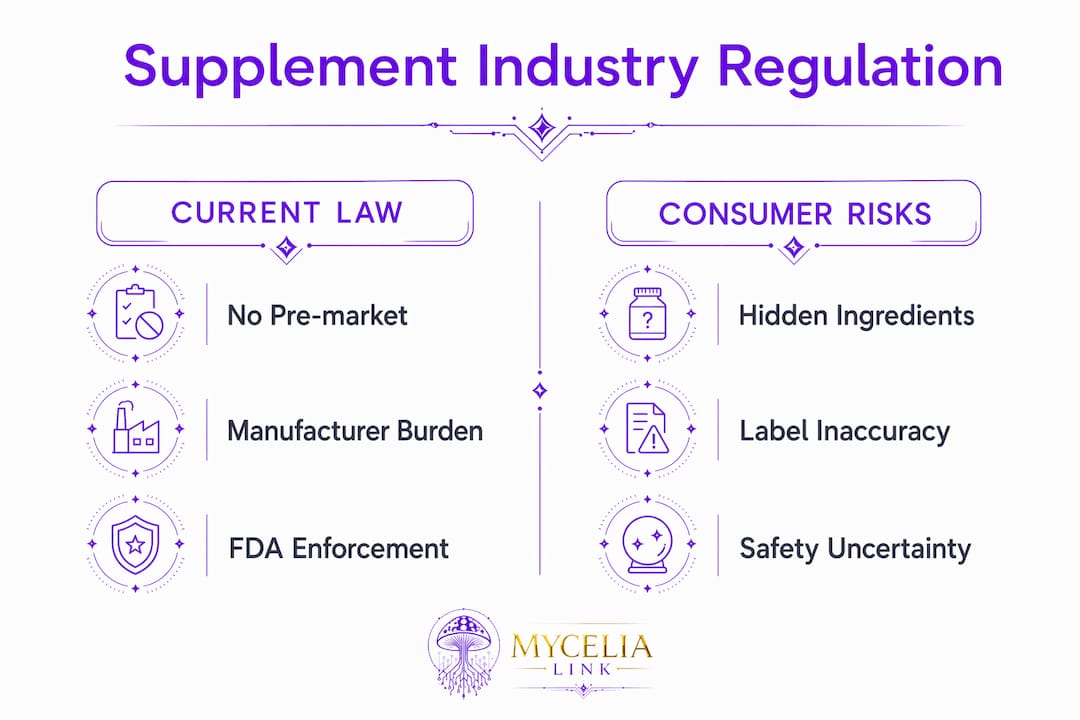
The supplement industry in the US operates under a framework where manufacturers do not have to prove safety or efficacy before selling products. This is the defining feature of how supplement industry lacks regulation: the Dietary Supplement Health and Education Act of 1994 (DSHEA) classifies supplements as foods, not drugs, which removes the pre-market approval requirement that applies to pharmaceuticals. The supplement market has grown from roughly 4,000 products in 1994 to approximately 100,000 products today. That scale makes meaningful oversight nearly impossible under the current reactive enforcement model.
How does the supplement industry lack regulation under federal law?
DSHEA is the legal foundation of supplement regulation issues in the US, and its core flaw is structural. Under DSHEA, supplements are presumed safe until the FDA proves otherwise. This is the opposite of how drug approval works, where manufacturers must submit clinical trial data before a product reaches shelves.
The FDA’s role under DSHEA is reactive, not preventive. The agency can only act after harm is reported, which means consumers absorb the risk during the window between a product’s launch and any enforcement action. The FDA does not review supplement labels before sale, does not verify health claims, and does not require manufacturers to submit safety data.
Key structural gaps in the current framework include:
- No pre-market safety proof required. Manufacturers self-certify that their products are safe.
- No pre-market efficacy proof required. A supplement can claim to support immune health without a single clinical trial.
- FDA bears the burden of proof. The agency must demonstrate harm before it can pull a product from the market.
- No comprehensive federal product registry. The FDA does not maintain a complete list of all marketed supplement products.
Pro Tip: When you see “These statements have not been evaluated by the Food and Drug Administration” on a label, that disclaimer is legally required precisely because the claim has not been verified. Treat it as a signal to research further, not a formality.
How does the lack of pre-market oversight put consumers at risk?
The absence of pre-market review creates direct risks in the areas of label accuracy, ingredient safety, and manufacturing quality. Manufacturers are responsible for ensuring safety and truthful labeling, but FDA inspections under current Good Manufacturing Practices (cGMPs) are infrequent. Independent testing has repeatedly uncovered discrepancies between what labels claim and what products actually contain.

The safety burden falls on consumers and healthcare providers by default. Most people mistakenly believe that a supplement on a pharmacy shelf has been vetted like a drug. That assumption is wrong, and it creates real exposure to contaminated, mislabeled, or adulterated products.
The practical risks from the unregulated supplement market include:
- Undisclosed ingredients. Products have been found to contain pharmaceutical compounds not listed on the label.
- Inaccurate dosing. Ingredient levels in tested products frequently differ from label claims, sometimes significantly.
- Unverified structure-function claims. Phrases like “supports cognitive function” require no scientific evidence, only a disclaimer.
- Contamination risk. Facilities with inconsistent cGMP compliance can introduce heavy metals, pesticides, or microbial contaminants.
The industry’s accountability gap shifts the safety determination burden to consumers and healthcare providers, who often treat shelf availability as a safety guarantee. That misplaced trust is one of the most consequential effects of the current regulatory model.
Pro Tip: Third-party certifications from organizations like NSF International or USP are not perfect, but they indicate that an independent lab has verified the product’s contents against its label. They are the closest thing to pre-market verification that currently exists.
What are the proposed federal and state changes to supplement oversight?
Federal and state governments are moving to address supplement regulation issues, though progress is uneven. The most significant federal proposal in 2026 is the Dietary Supplement Listing Act, introduced by Senator Durbin. It would require manufacturers to register their products with the FDA, creating a public database of marketed supplements for the first time.
The FDA’s Office of Dietary Supplement Programs is also modernizing its oversight approach, with work on new dietary ingredient (NDI) pathways and improved safety evaluation processes. These efforts are ongoing but gradual, and they do not yet change the fundamental pre-market approval gap.
At the state level, the picture is fragmented. New York’s age restrictions on supplement sales represent one example of states acting where federal law has not. Several states have introduced labeling requirements that go beyond federal minimums. This patchwork of rules creates compliance complexity for manufacturers and uneven protection for consumers depending on where they live.
| Reform type | Current status | Consumer impact |
|---|---|---|
| Federal product registry | Proposed (2026 Dietary Supplement Listing Act) | Would create first public database of marketed supplements |
| NDI safety pathways | FDA modernization in progress | Gradual improvement in ingredient safety review |
| State age restrictions | Active in select states (e.g., New York) | Limits youth access but varies by location |
| State labeling laws | Patchwork across multiple states | Inconsistent protection depending on state of purchase |
The complex regulatory patchwork of fast-moving state legislation alongside federal uncertainty creates compliance challenges for manufacturers and leaves consumers without a consistent national standard.
How can you navigate the unregulated supplement market safely?
Consumer safety in supplements depends heavily on your ability to evaluate products independently, because the regulatory system does not do it for you. The following steps reduce your exposure to the most common risks in the unregulated supplement market.
-
Read the FDA disclaimer as a warning, not a formality. The statement that claims have not been evaluated by the FDA signals that marketing claims skirt drug approval requirements. Do not take structure-function claims at face value.
-
Look for third-party testing credentials. NSF International, USP, and Informed Sport are independent organizations that test products against label claims. A certification from one of these bodies is meaningful evidence of quality control.
-
Be cautious with discount products. Low-cost supplements are more likely to cut corners on manufacturing quality, ingredient sourcing, and testing. Price alone is not a reliable indicator, but unusually low prices in a category with high ingredient costs deserve scrutiny.
-
Check for transparency in sourcing and manufacturing. Brands that publish their testing results, disclose their ingredient sources, and explain their manufacturing standards give you the information you need to make an informed choice. Brands that do not provide this information are relying on your trust rather than earning it.
-
Use regulatory databases when available. The FDA’s MedWatch database tracks adverse event reports. Searching a product or ingredient there can surface safety signals that predate any formal enforcement action.
-
Talk to a healthcare provider before starting any new supplement. This is especially relevant for products that interact with medications or target specific health conditions. A provider can cross-reference your health profile against known risks.
Understanding why contaminated supplements reach shelves in the first place helps you ask better questions before you buy. The manufacturing and audit gaps are real, and informed consumers are the most effective check on a system that does not yet protect them adequately.
Key Takeaways
The supplement industry’s lack of pre-market regulation under DSHEA 1994 places the entire burden of safety verification on consumers, not manufacturers or the FDA.
| Point | Details |
|---|---|
| DSHEA removes pre-market review | Manufacturers sell supplements without proving safety or efficacy to any federal body. |
| FDA acts only after harm | Enforcement is reactive, meaning consumers bear risk during the gap between launch and action. |
| Label accuracy is not guaranteed | Independent testing consistently finds discrepancies between label claims and actual contents. |
| Reform is underway but slow | The 2026 Dietary Supplement Listing Act proposes the first federal product registry, but it is not yet law. |
| Third-party testing is your best tool | Certifications from NSF International or USP provide the closest available substitute for pre-market review. |
The regulatory gap is bigger than most consumers realize
At Mycelia Link, we have spent years watching consumers make decisions based on a false premise: that a supplement on a store shelf has been checked by someone. It has not. The FDA’s post-market enforcement model means that a product can be sold, consumed, and cause harm before any regulatory action begins. That is not a minor technicality. It is the defining feature of how this industry operates.
What concerns us most is not the bad actors who knowingly sell adulterated products. It is the well-intentioned brands that simply do not invest in rigorous testing because the law does not require it. The result is a market where quality varies enormously and consumers have no reliable way to tell the difference from a label alone.
The proposed Dietary Supplement Listing Act is a step in the right direction, but a product registry does not equal safety testing. Real reform requires pre-market notification at minimum, and ideally some form of safety data submission for new ingredients. Until that happens, the most honest advice we can give is this: treat every supplement as unverified until you have evidence otherwise. Third-party testing, transparent sourcing, and published manufacturing standards are not marketing extras. They are the minimum standard for a product you are putting in your body.
— Mycelia Link Industries
Mycelia Link’s approach to supplement transparency
The regulatory gaps described in this article are exactly why Mycelia Link built its product line around third-party testing, transparent sourcing, and published quality standards. Consumers deserve to know what is in their supplements before they take them.
Mycelia Link’s mushroom supplement catalog and peptide wellness resources are designed for consumers who want evidence, not marketing language. Every product comes with clear documentation of what it contains and how it was tested. If you want to understand how to evaluate transparency claims on any supplement label, Mycelia Link’s educational guides give you the framework to do it.
FAQ
What law governs supplement regulation in the US?
The Dietary Supplement Health and Education Act of 1994 (DSHEA) is the primary federal law governing supplements. It classifies supplements as foods rather than drugs, removing the pre-market safety and efficacy requirements that apply to pharmaceuticals.
Does the FDA approve supplements before they are sold?
The FDA does not approve supplements before sale. Under DSHEA, manufacturers are responsible for safety, and the FDA can only act after a product is already on the market and harm has been reported.
What does the FDA disclaimer on supplement labels mean?
The statement “These statements have not been evaluated by the Food and Drug Administration” means the health claim on the label has not been reviewed or verified by any federal agency. It is a legally required disclosure, not a minor formality.
What is the Dietary Supplement Listing Act of 2026?
The Dietary Supplement Listing Act of 2026 is a proposed federal law that would require manufacturers to register their products with the FDA, creating the first public database of marketed supplements in the US.
How can you tell if a supplement has been independently tested?
Look for certifications from NSF International, USP, or Informed Sport on the product label or the brand’s website. These organizations test products against their label claims and provide the closest available substitute for pre-market regulatory review.
Recommended
Categories:
Related Posts
 Top 4 Ascendbiolabs.com Alternatives for 2026
Explore 4 ascendbiolabs.com alternatives to compare and choose suitable wellness products for your needs in
 Why Filler Ingredients Are Used in Supplements
Discover why filler ingredients are used in supplements. Learn how they enhance quality, safety, and