



Loading your cart...

Sourcing research peptides safely requires meeting a purity threshold of at least 98%, demanding lot-specific Certificates of Analysis, and staying within the legal framework that classifies these compounds as research-use chemicals. Research peptides are synthetic amino acid chains sold legally in the US, UK, and EU as research chemicals, labeled “not for human or animal use.” This source research peptides safely guide covers every critical checkpoint: purity standards, documentation requirements, supplier evaluation, proper storage, and the most common mistakes that cost researchers both money and credibility. Mycelia Link built its entire peptide catalog around these exact standards, so every point here reflects real sourcing practice.
What documents and certifications verify peptide quality?
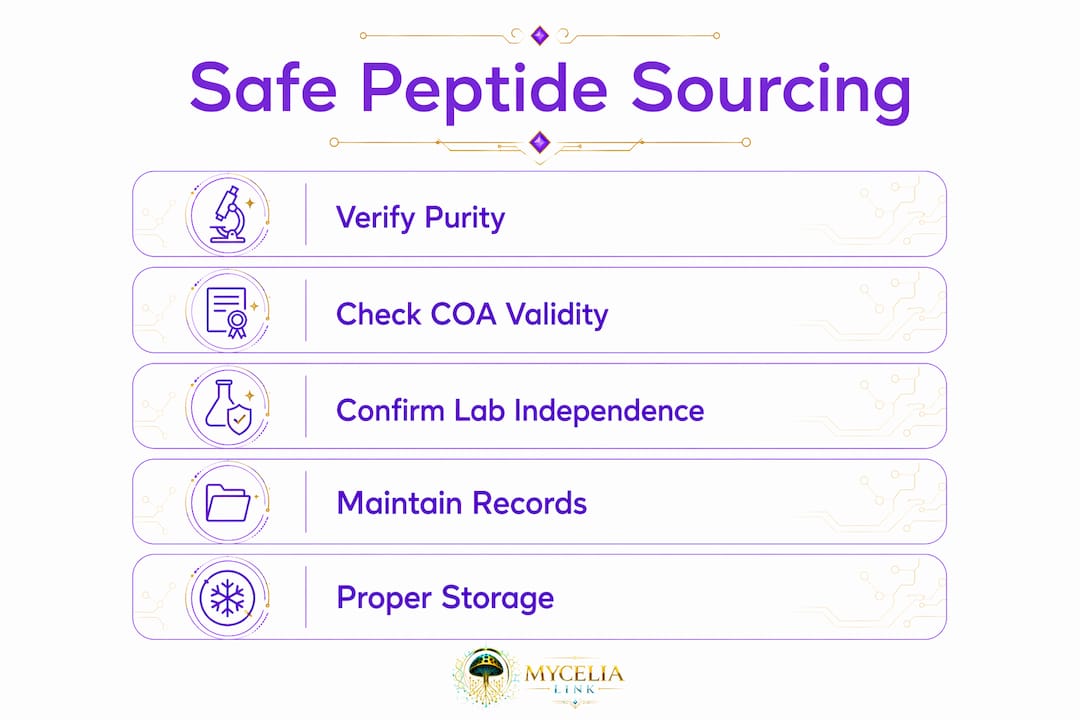
A valid Certificate of Analysis is the single most important document in peptide sourcing. Without it, you have no objective basis for trusting what is in the vial. The COA must be lot-specific, meaning the batch number on the document matches the batch number printed on the vial itself.
A trustworthy COA includes the following elements:
- Batch number that matches the physical product label exactly
- HPLC purity result showing ≥98%, with 99% as the gold standard for purity in 2026
- Mass spectrometry identity confirmation verifying the molecular weight matches the target peptide
- Testing date and manufacturing date so you can assess freshness and shelf life
- Name and contact details of the testing laboratory
The difference between a supplier-provided COA and an independent third-party COA matters enormously. Supplier in-house labs have a direct financial interest in reporting favorable results. ISO 17025-accredited labs like Janoshik Analytical operate under strict external oversight and have no stake in the outcome. Their results are far more reliable.
Pro Tip: Contact the third-party lab named on the COA directly to confirm the report is authentic. A legitimate lab will verify the batch on request. If the lab cannot confirm the report, treat the COA as invalid.
Reading an HPLC chromatogram takes practice, but the core principle is simple. A single sharp peak at the correct retention time indicates high purity. Multiple peaks or a broad baseline signal contamination or degradation. Mass spectrometry adds identity confirmation by matching the measured molecular weight to the theoretical weight of the target peptide. Both tests together give you a complete quality picture.
Research peptides are legally sold as research chemicals only. Any supplier making health claims, dosing recommendations, or therapeutic promises is operating outside regulatory norms. That framing is not just a legal technicality. It signals that the supplier does not understand or respect the compliance framework, which raises serious questions about their testing rigor as well.
How do you evaluate and choose reliable peptide suppliers?
Supplier evaluation starts with auditability, not price. A supplier willing to share batch-specific third-party testing data on demand is demonstrating accountability. One who deflects, delays, or offers only generic documentation is not.
Follow these steps when vetting a new supplier:
- Request the COA before ordering. A legitimate supplier provides it without hesitation. Hesitation or refusal is a disqualifying red flag.
- Verify business legitimacy. Check for a real business address, customer service contact, and a clear legal disclaimer stating research-use-only status.
- Assess transparency of testing documents. Confirm the COA names an independent lab, not just the supplier’s own facility.
- Place a small first order. Send that initial batch to an independent lab for testing before scaling. This step costs roughly $150 and protects you from investing in an unreliable source.
- Inspect packaging on arrival. Lyophilized powder in sealed glass vials with tamper-evident closures is the correct physical form. Anything else warrants immediate concern.
- Confirm shipping protocols. Temperature-controlled shipping with cold packs is standard for quality suppliers. Untracked or ambient-temperature shipping of peptides signals poor handling practices.
Pro Tip: Keep a supplier scorecard. Rate each vendor on COA quality, lab independence, packaging condition, shipping method, and response time to documentation requests. This record becomes your reference when scaling orders or onboarding new compounds.
Price alone is a misleading quality metric. Prices far below market average almost always indicate poor synthesis quality, inadequate testing, or fraudulent sourcing. The cost of proper HPLC and mass spectrometry testing is real, and legitimate suppliers build it into their pricing. A suspiciously low price means someone cut a corner, and that corner is usually quality verification.

Maintaining a chain-of-custody record means saving every COA, HPLC report, mass spectrometry result, and procurement receipt. This documentation protects you legally and scientifically. If a research result is ever questioned, your paper trail demonstrates that the compound met verified standards at the time of use.
What are the best practices for peptide storage and handling?
Proper storage preserves the integrity of your peptides from the moment they arrive. A compound that passed a 99% purity test at the lab can degrade to unusable quality within weeks if stored incorrectly.
Key storage and handling rules:
- Store lyophilized powder at -20°C minimum. Optimal long-term storage is at -80°C. Room temperature storage degrades peptides quickly, often within days for sensitive sequences.
- Avoid repeated freeze-thaw cycles. Each cycle introduces moisture and mechanical stress that breaks peptide bonds. Aliquot your stock into single-use portions before freezing.
- Protect from light exposure. UV light accelerates oxidation. Store vials in opaque containers or amber glass when possible.
- Inspect packaging on arrival. Lyophilized powders in sealed glass vials shipped with temperature control maintain stability and research validity. Any sign of moisture, clumping, or broken seals means the compound may already be compromised.
- Log storage conditions. Record the date received, storage location, temperature, and any reconstitution dates. This log is part of your chain-of-custody documentation.
Shelf life varies by peptide sequence and storage conditions. Most lyophilized peptides remain stable for 12–24 months at -20°C when kept dry and away from light. Once reconstituted in bacteriostatic water, stability drops significantly. Use reconstituted peptides within 30 days and keep them refrigerated at 2–8°C. Never refreeze a reconstituted solution.
What common mistakes should you avoid when sourcing peptides?
The peptide market has no central regulatory authority. That absence places the entire burden of quality verification on the researcher. Most sourcing failures trace back to a small set of predictable errors.
Accepting a generic, non-lot-specific COA is the single most common mistake in peptide sourcing. A COA without a batch number that matches your vial is not a quality guarantee. It is a marketing document.
Avoid these specific errors:
- Buying on price alone. The cheapest option in an unregulated market is almost never the safest. Quality synthesis and independent testing cost money.
- Accepting non-lot-specific COAs. Generic COAs or restricted access to testing data are disqualifying red flags. Batch-specific documentation is non-negotiable.
- Skipping first-order independent testing. Trusting a supplier’s documentation without independent verification is a gamble. The $150 cost of a single independent lab test is far cheaper than scaling an order of substandard product.
- Ignoring legal classification. Sourcing from suppliers who make health or therapeutic claims puts you in a legally ambiguous position. Stick to suppliers who clearly label products as research-use only and link to their terms and conditions for compliance context.
- Neglecting packaging and shipping inspection. A vial that arrived warm or shows moisture contamination is compromised regardless of what the COA says.
The lot-specific COA requirement with batch number linkage and independent lab details is the clearest line between a trustworthy supplier and one operating on reputation alone. Every other quality signal flows from that document.
Key Takeaways
Safe peptide sourcing depends on three non-negotiable pillars: verified purity at ≥98% by HPLC and mass spectrometry, lot-specific Certificates of Analysis from ISO 17025-accredited labs, and complete chain-of-custody documentation from order to storage.
| Point | Details |
|---|---|
| Purity threshold | Demand ≥98% purity by HPLC and mass spectrometry identity confirmation for every batch. |
| Lot-specific COA | Batch numbers on the COA must match the vial; generic COAs are not acceptable quality proof. |
| Independent lab testing | ISO 17025-accredited third-party labs eliminate conflicts of interest that supplier labs cannot. |
| First-order verification | Test your first batch independently before scaling; the cost is roughly $150 and prevents larger losses. |
| Cold storage protocol | Store lyophilized peptides at -20°C minimum, avoid freeze-thaw cycles, and log all storage conditions. |
What I have learned about sourcing peptides in a market with no referee
The peptide market in 2026 is more accessible than ever and more variable in quality than most researchers expect. Suppliers range from genuinely rigorous operations with full independent testing to storefronts that print professional-looking COAs with no real analytical backing. The gap between them is not always visible from a website.
What I have found after working through this space is that auditability is the only reliable signal. A supplier who welcomes scrutiny, shares lab contact details, and responds quickly to documentation requests is behaving like a legitimate operation. One who deflects or offers vague reassurances is not. Price, website design, and customer reviews are all secondary to that single criterion.
The practice of placing a small first order and sending it to an independent lab before committing to volume is not optional for serious researchers. It is the minimum standard of due diligence. The $150 cost of that test is the cheapest insurance available in this market.
Researchers also carry a responsibility that goes beyond their own work. Sloppy sourcing practices, poor documentation, and ignoring legal classification all contribute to a market environment where bad actors thrive. When you hold suppliers to a high standard, you make the market marginally better for everyone working in it. That is not idealism. It is how professional research communities self-regulate when formal oversight is absent.
Mycelia Link was built on the premise that transparency in wellness product sourcing should be the default, not the exception. Every product we carry reflects that standard.
— Mycelia Link Industries
Trusted peptide research resources from Mycelia Link
Mycelia Link carries a curated selection of research peptides backed by third-party testing documentation and clear research-use labeling.
The 2026 peptide wellness research guide on the Mycelia Link site walks through real application examples with sourcing and documentation context built in. For researchers ready to review specific compounds, the Mycelia Link peptide catalog lists available products with transparent sourcing standards. Every listing reflects the purity thresholds, COA requirements, and storage protocols covered in this article. No inflated prices, no opaque marketing, and no shortcuts on verification.
FAQ
What purity level should research peptides meet?
Research-grade peptides must meet a minimum purity of 98% as measured by HPLC, with 99% recognized as the gold standard. Mass spectrometry identity confirmation is required alongside HPLC to verify the compound is what the label claims.
What makes a Certificate of Analysis valid?
A valid COA is lot-specific, meaning the batch number on the document matches the batch number on the vial. It must also name an independent testing laboratory and include HPLC purity results, mass spectrometry data, and testing dates.
Are research peptides legal to buy?
Research peptides are legally sold in the US, UK, and EU as research chemicals labeled “not for human or animal use.” Suppliers who make health or therapeutic claims operate outside standard regulatory norms and should be avoided.
How do I verify a supplier’s testing claims?
Contact the third-party laboratory named on the COA directly and ask them to confirm the batch report. A legitimate lab will verify the analysis on request. If the lab has no record of the batch, the COA is not authentic.
How should I store research peptides after sourcing?
Store lyophilized peptides at -20°C minimum, ideally at -80°C for long-term stability. Avoid repeated freeze-thaw cycles by aliquoting into single-use portions before freezing, and protect vials from light exposure at all times.
Recommended
Categories:
Related Posts
 Wellness Biomarkers Explained: Your 2026 Health Guide
Discover what wellness biomarkers are explained and how they reveal vital insights into your health.
 Why Discount Supplements Risk Quality: What to Know
Discover why discount supplements risk quality. Learn how low prices can lead to unsafe or