

Loading your cart...

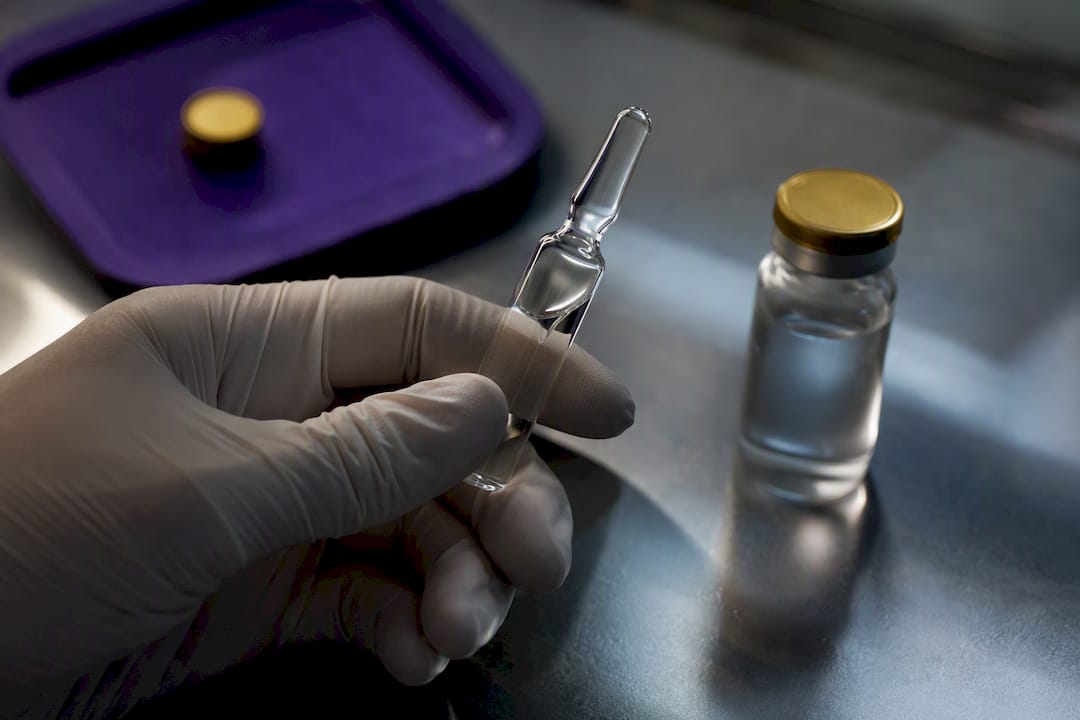
Lyophilized peptides are freeze-dried peptide powders, and they stay substantially more stable than dissolved peptide solutions when kept dry at ≤ -20°C. The single biggest mistake researchers make on receipt is opening the vial before it reaches room temperature in a desiccator, which invites moisture into the powder. Reconstitution isn’t a guessing game either. It has to follow a sequence-guided solvent plan, worked out before you ever crack the seal.
TL;DR:
- Lyophilized peptides remain stable for years at or below -20°C, but improper storage or sealing can cause moisture ingress that accelerates degradation.
- Peptides containing residues like cysteine, methionine, or tryptophan degrade faster, especially if not stored in colder, anaerobic environments.
- Long-term storage at -20°C or -80°C in airtight, desiccant-packed vials is essential to prevent moisture and temperature cycle-related stability loss.
- Reconstitution should follow a sequence-guided solvent plan based on peptide sequence, starting with water and escalating to organic solvents or chaotropes as needed.
- Routine handling practices, including equilibrating vials, weighing under controlled conditions, and documenting storage details, significantly reduce variability between experiments.
Table of Contents
- What Is Lyophilization and How Does It Change Peptide Stability?
- How Long Do Lyophilized Peptides Actually Last?
- What Storage Conditions Keep Lyophilized Peptides Stable?
- How Do You Reconstitute Lyophilized Peptides Without Wasting Material?
- What Are the Warning Signs of a Degraded Peptide?
- What Lab Practices Reduce Peptide Waste and Variability?
- How Mycelia Link’s Resources Support These Protocols
- Why Reproducibility Starts Before the Experiment
- Where to Find COA-Backed Peptides and Reconstitution Protocols
- Sources
What Is Lyophilization and How Does It Change Peptide Stability?
Lyophilization freezes a peptide solution, then pulls the water out under vacuum in two stages: primary drying, where ice sublimates directly to vapor, and secondary drying, which removes bound water still clinging to the peptide matrix. What’s left in the vial is a porous powder cake, plus whatever buffer salts, counterions, or lyoprotectants were part of the original formulation.
Removing water matters because most peptide degradation, hydrolysis of the peptide backbone and microbial growth, needs water to happen. A dry powder shuts down both pathways almost entirely, which is why lyophilized peptides remain stable for years under appropriate conditions while the same peptide in solution might degrade within weeks.
But drying isn’t a cure for every instability mechanism. Oxidation-prone residues can still react with trace atmospheric oxygen even in the solid state, and deamidation reactions in certain sequences don’t fully stop just because water is gone. Lyophilization also doesn’t fix a bad start. If the freeze-drying cycle leaves residual moisture above target levels, or the vial packaging lets humidity creep back in overtime, you get a powder that looks lyophilized but behaves like it never was. That’s usually where “the peptide went bad in the freezer” complaints actually originate. It’s not the freezer. It’s incomplete drying or a compromised seal.

How Long Do Lyophilized Peptides Actually Last?
Expect a real gap between what a peptide tolerates in transit and what it needs for long-term storage. Most vendors ship lyophilized peptides at ambient temperature for short periods without meaningful loss, since the dry state buys that cushion. Long-term storage is a different requirement entirely, and it starts the moment the vial lands on your bench.
Sequence composition drives most of the variability in shelf life. Peptides containing cysteine, methionine, tryptophan, asparagine, or glutamine, along with sequences that are heavily acidic or basic, tend to degrade faster than simpler ones because those residues are prone to oxidation or deamidation even in dry storage. Bachem’s handling guidelines flag these residues specifically as reasons to consider anaerobic or colder storage for a given synthesis.
A controlled study tracking peptide digests over eight weeks found that combining cold storage with a volatile acidic buffer (0.1% TFA) measurably slowed peptide loss compared to warmer or purely aqueous conditions, based on spectral counting data published in PMC. That’s a useful data point for anyone deciding how to store reconstituted material, not just the dry powder.
Residual moisture and temperature cycling are the two variables that quietly erode vendor shelf-life estimates. Vendor stability certificates typically assume the vial stays sealed, dry, and at a consistent temperature. Treat that number as a starting estimate, not a guarantee, and build in your own re-check, a quick mass comparison or a re-run through LC-MS, if a vial has been open, moved between freezers, or stored longer than six months.
What Storage Conditions Keep Lyophilized Peptides Stable?
Temperature and moisture control do most of the work here, and neither is complicated to get right once it’s built into lab routine.
For most research peptides, -20°C is the recommended baseline for long-term storage, with -80°C reserved for peptides you need to keep viable for years or ones with particularly labile residues. The rationale is straightforward: lower temperatures slow every degradation reaction that can still occur in the solid state, even ones that don’t strictly require water.
Moisture control is just as important as temperature, arguably more so for day-to-day reliability:
- Store vials with desiccant packs inside a sealed secondary container, not loose in a freezer drawer.
- Use vacuum-sealed bags or airtight containers for peptides you’re not accessing often.
- Choose amber glass vials with tight-sealing caps to limit both light exposure and air exchange.
- For oxidation-sensitive sequences, purge the vial headspace with argon or nitrogen before resealing, a step Bachem’s guidance specifically recommends for cysteine- and methionine-containing peptides.
- Avoid frost-free freezers entirely. Their automatic defrost cycles introduce repeated temperature swings and humidity spikes that dry powders are not built to tolerate.
Pro Tip: Log every freezer door-opening event for your most sensitive peptides. If a vial has cycled through five or six brief warm-ups over a year, that’s often the real explanation for a stability problem, not a bad synthesis batch.
When a shipment arrives, check for an intact cold pack or dry ice residue, confirm the vial cap is undamaged, and move the peptide into proper storage within the hour rather than leaving it on a bench overnight.

How Do You Reconstitute Lyophilized Peptides Without Wasting Material?
There’s no single solvent that works for every peptide, and treating reconstitution as an afterthought is how labs waste expensive material on failed dissolution attempts. NIBSC’s technical guidance is blunt about this: work through a solvent ladder based on the peptide’s actual sequence, not habit.
Start with the sequence, not the vial. A peptide’s net charge and hydrophobicity at neutral pH predict which solvent it will actually dissolve in, and testing that prediction on a small pilot volume first saves the rest of your stock for real experiments, an approach Sigma-Aldrich’s own protocol recommends explicitly.
- Try water first. Neutral, low-hydrophobicity peptides often dissolve cleanly in sterile water or PBS.
- Move to 0.1% acetic acid for peptides with basic residues that need a slightly acidic environment to stay in solution.
- Try a dilute base (0.1% ammonium hydroxide) for acidic peptides that resist the acid approach.
- Switch to organic solvents like DMSO, acetonitrile, or DMF for hydrophobic or aggregation-prone sequences.
- Reach for chaotropes (guanidine HCl, urea) only as a last resort, since they complicate downstream assay compatibility.
Sonicate briefly between attempts rather than vortexing hard, which can shear or aggregate some peptides. When you’re diluting a concentrated organic stock into aqueous buffer for an assay, add it dropwise while gently agitating. Dumping it in all at once is a reliable way to trigger localized precipitation that never fully redissolves.
Pro Tip: If your assay can’t tolerate DMSO or acetonitrile, dissolve in the organic solvent first to confirm solubility, then re-lyophilize before reconstituting a second time in an assay-compatible aqueous buffer. It costs you one extra step and saves you a ruined plate.
Once reconstituted, split the stock into single-use aliquots immediately. Peptide solutions have a real shelf life, not the multi-year runway of the dry powder, and repeated freeze-thaw cycling degrades material fast enough that an aliquot strategy pays for itself within a few experiments. Keep aliquots at ≤ -20°C in pH 5 to 6 sterile buffer when long-term liquid storage is unavoidable.

What Are the Warning Signs of a Degraded Peptide?
Visual inspection catches more problems than most researchers give it credit for, especially before committing a vial to an expensive experiment.
- Deliquescence (the powder looks wet, sticky, or has partially liquefied) almost always means moisture got in, either from a compromised seal or an equilibration step that was skipped.
- Color change, especially yellowing or browning in a peptide that should be white, often signals oxidation, particularly in methionine or tryptophan-containing sequences.
- A crusty film or “scum” on the vial walls can indicate the peptide has partially degraded into smaller fragments or aggregated.
- Persistent particulates after reconstitution that don’t clear with sonication suggest aggregation or an incompatible solvent choice, not necessarily degradation.
When something looks off, cheap checks beat guessing. Weigh the vial and compare it against the label, since a mass mismatch flags moisture uptake immediately. If you have LC-MS access, run a quick purity check against the original certificate of analysis. Where full instrumentation isn’t available, run the reconstituted material through a small control assay you already trust before committing it to a real experiment.
If the mass is off but the peptide dissolves cleanly and passes a control assay, re-lyophilizing may salvage it. If color change or persistent particulates show up alongside failed assay performance, request a replacement from the vendor rather than troubleshooting further, particularly for oxidation-prone sequences where the damage is often irreversible.
What Lab Practices Reduce Peptide Waste and Variability?
A few habits, applied consistently, eliminate most of the variability that shows up between labs running the “same” peptide.
- Equilibrate before opening. Pull the vial from the freezer and let it reach room temperature inside a desiccator, never on an open bench, before breaking the seal.
- Weigh on a calibrated microbalance immediately after opening, and work quickly to limit the powder’s exposure to ambient humidity.
- Reseal properly. Purge headspace with inert gas for oxidation-sensitive peptides, and use a tight-capped, amber vial for any material going back into storage.
- Wear a mask or work in a fume hood when weighing fine peptide powders, since airborne particulates are an inhalation risk during transfer.
- Aliquot immediately after reconstitution, and label each tube with concentration, solvent, and preparation date to avoid guesswork three months later.
- Document shipment condition on arrival, cold pack status, cap integrity, and any temperature excursion, so a stability complaint later has a paper trail instead of a shrug.
How Mycelia Link’s Resources Support These Protocols
Mycelia Link built its ‘8 Step Peptide Reconstitution for Researchers With COA Checks’ around this exact sequence-first logic: confirm the certificate of analysis, equilibrate, pilot-test solubility, then scale up. It’s designed to complement the solvent ladder above rather than replace your own judgment about a given sequence.
The peptide solubility workflow walks through 1 to 2 mg/mL stock preparation using the same sequence-first approach. And independent certificates of analysis matter more than most researchers assume: knowing the actual verified mass and purity of what’s in the vial, rather than trusting a label alone, removes one entire source of experimental variability before you’ve even opened the cap.
Why Reproducibility Starts Before the Experiment
Most stability failures I’ve seen traced back to inconsistent handling, not bad chemistry. A lab that equilibrates one batch and skips it on the next, or reconstitutes by feel instead of a documented solvent sequence, builds noise into its own data before the first pipette touches a plate.
Requesting a COA isn’t a formality. It’s the only way to know whether a stability problem is real degradation or a mass discrepancy that was there from day one. Pair that with a written log of storage temperature, equilibration steps, and solvent choice for every peptide in the freezer, and half of what looks like “peptide variability” between experiments disappears. Standardizing handling is cheaper than repeating a failed run.
— Mycelia Link Industries
Where to Find COA-Backed Peptides and Reconstitution Protocols
Every stability and handling decision covered here depends on knowing exactly what’s in the vial before you start, and that starts with sourcing. Third-party certificates of analysis are listed alongside a research peptide catalog, allowing checking of purity and mass data before committing a peptide to a protocol rather than after a failed assay.

The peptides category page carries the current catalog with COA documentation attached to each listing, and the peptide wellness research guide walks through the reconstitution SOP referenced above in full, step by step. If you’re setting up aliquoting for a multi-peptide study or have questions about a specific sequence’s solubility profile, that guide is the fastest starting point. Check the COA on your next order before it ships, not after it arrives.
Sources
- Peptide Storage and Handling Guidelines
- Synthetic Peptide Handling & Storage Protocol
- Handling and storage guidelines for peptides
- Study: Effects of storage temperature and buffer on peptide stability (PMC)
- Peptide storage and dissolution guidance (NIBSC)
Recommended
Categories:
Related Posts
 Peptide Researchers: Bacteriostatic or Sterile Water for 28 Day Use
Peptide researchers' guide to bacteriostatic vs sterile water: when to reuse, why concentration math doesn't
 3–6 g/day Tested Cordyceps: What Science Supports and How to Choose
An evidence first guide to cordyceps: human trial findings, dosing (most studies use 3–6 g/day),